Amazon Accounting Software: A Data Management Platform for E-commerce Sellers
1.What Is Amazon Accounting Software and Why Do Sellers Need It?
Amazon accounting software refers to a software that connects directly to your Amazon seller account to automatically collect, standardize, and process all business data generated across your operations. Instead of working with multiple disconnected reports, businesses can centralize their data into a single source of truth, making it easier to track revenue, expenses, and profitability.
Unlike sales dashboards that simply visualize operational performance, Amazon accounting software transforms transaction data into financial data. It goes beyond recording sales by processing Amazon fees, advertising costs, refunds, returns, and settlement adjustments to provide an accurate picture of business profitability.
This becomes especially important when businesses need to answer questions such as:
-
Does this month's recorded revenue match the amount Amazon actually transferred?
-
After deducting FBA fees, referral fees, advertising costs, and refunds, how much profit remains?
-
Do internal reports reconcile with accounting records and financial statements?
True Amazon accounting software does more than store data, it creates a unified foundation where every business decision is based on standardized, reliable information.
2. The Biggest Challenge for Amazon Sellers: Growing Businesses Create Scattered Data
As businesses expand across more ASINs, marketplaces, and higher order volumes, Amazon data quickly becomes fragmented. Revenue, marketplace fees, advertising costs, refunds, and settlements are all recorded within Amazon Seller Central, but across separate reports. While each report is accurate on its own, none provides a complete financial picture.
As a result, businesses spend increasing amounts of time reconciling revenue against settlement payments, calculating profitability by ASIN, and consolidating data before financial reporting. The larger the business grows, the more time is spent managing data instead of making decisions. At this stage, companies no longer need more reports - they need a system that centralizes, standardizes, and connects their data into a single source of truth.
3. How Does Amazon Accounting Software Solve This Problem?
Amazon accounting software does far more than consolidate data from Amazon Seller Central into one place. Its real value lies in standardizing and connecting fragmented operational data into a unified financial dataset. Only then can businesses reconcile transactions accurately, track profitability, and generate reliable financial reports.
3.1 Monitor Business Performance in Real Time
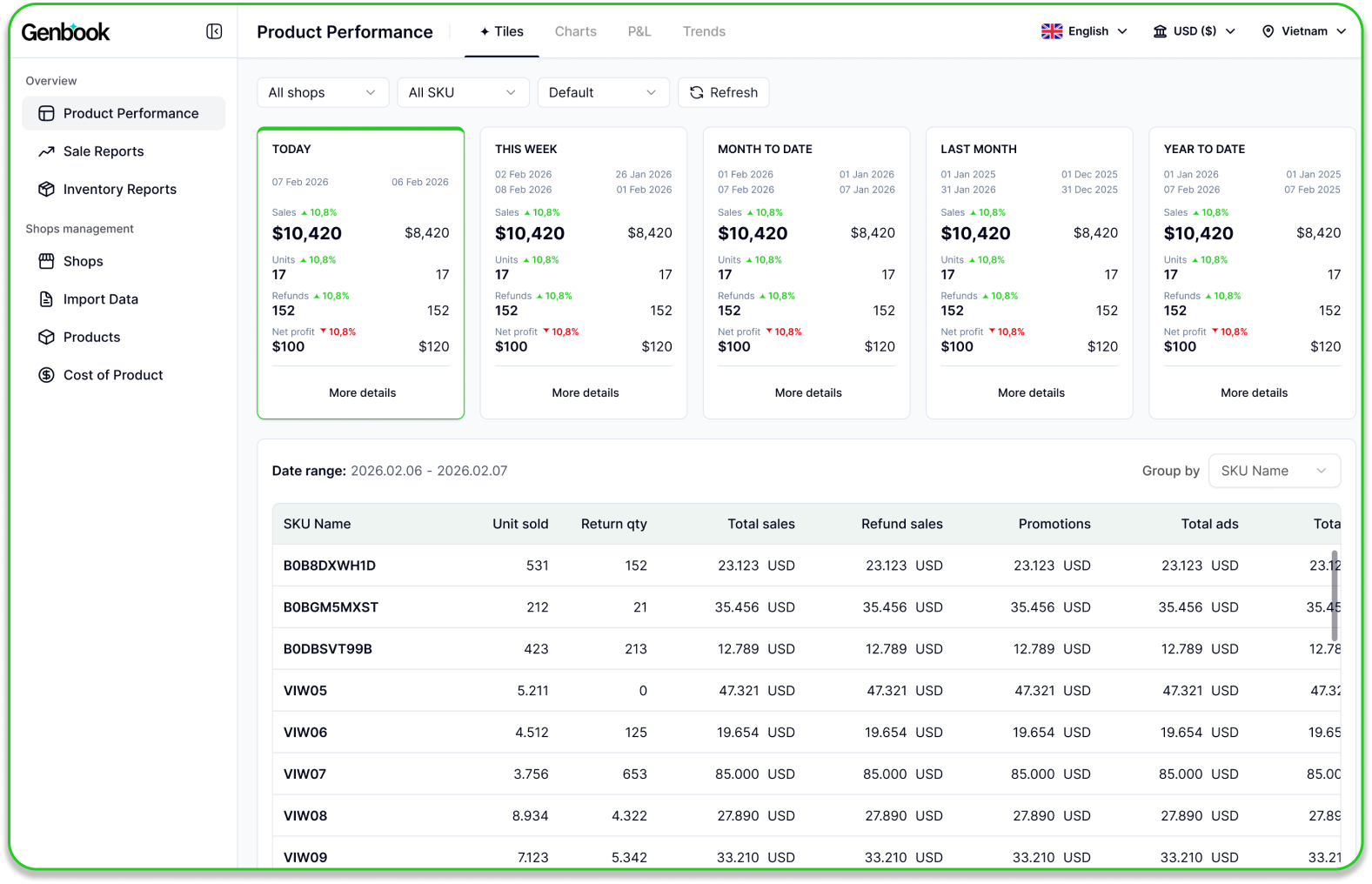
With all sales data centralized in one system, businesses can:
• Track revenue by day, week and month on a single timeline.
• Watch growth trends rather than absolute figures alone.
• Compare performance across active marketplaces.
• See near real-time business status without waiting for month-end close.
The value of real-time visibility is not simply faster reporting - it is faster decision-making. The earlier a business identifies an issue, the sooner it can adjust pricing, advertising budgets, or inventory planning before performance is significantly affected.
3.2 Track Profitability by ASIN
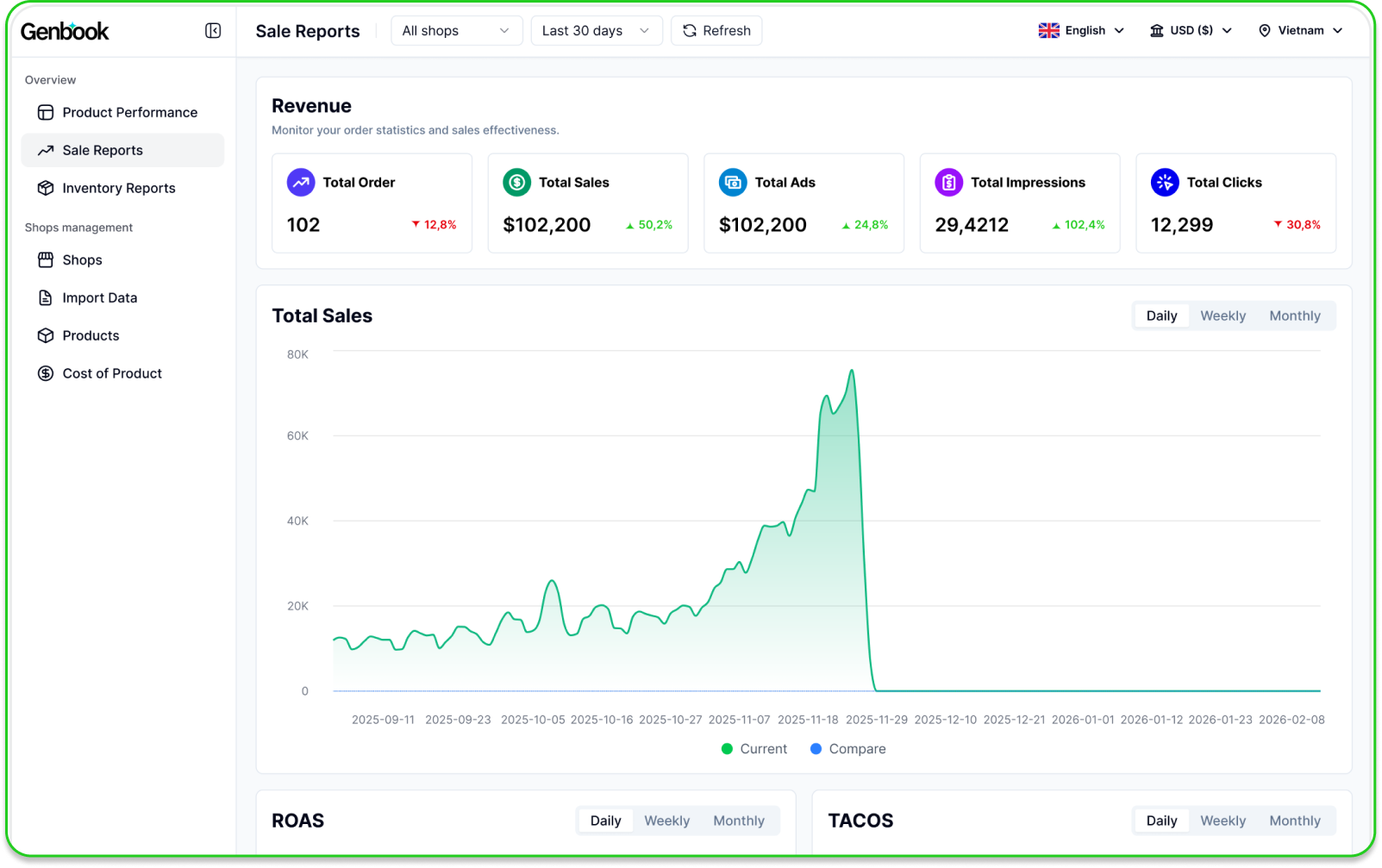
At account level, revenue can keep climbing while a group of products quietly drags margin down. The issue only appears once profit per SKU is isolated, meaning profit on each item after landed cost, marketplace fees, advertising spend and returns are all allocated to it.
• Identify ASINs (Amazon Standard Identification Numbers) with genuine growth.
• Catch products losing sales volume or losing margin early.
• Assess listing performance on conversion data rather than intuition.
• Adjust Amazon Ads budgets and purchase orders against real profit.
Decisions around advertising, purchasing, and product expansion can therefore be based on profitability rather than sales volume alone.
3.3 Manage Returns and Refunds Effectively
Returns and refunds not only reduce revenue but also directly impact the profitability of individual ASINs. Without continuous monitoring, businesses may overlook products that generate strong sales while consistently producing high return rates that erode margins over time. With an appropriate accounting software, sellers can:
• Track return trends over time instead of case by case.
• Analyse refund rates by product and by marketplace.
• Isolate the cause: quality, listing description or fulfilment.
• Protect account performance metrics and product ratings.
Early detection helps minimize profit leakage while improving operational performance and product quality.
3.4 Build Financial Reports from a Single Source of Data
The greatest value of Amazon accounting software is not its dashboards or visual reports, but its ability to transform operational data into financial information. When revenue, expenses, and cash flow are standardized and reconciled within the same system, businesses can generate both management reports and Amazon financial reports from a single, trusted data source.
This significantly reduces manual consolidation, minimizes inconsistencies across departments, and enables faster decision-making based on data that can be verified and trusted.
4. Genbook: From Amazon Data to Accounting-Ready Financial Reports
Many tools on the market help Amazon sellers track sales performance or visualize data. However, when businesses need to reconcile transactions, calculate accurate profitability, or prepare financial statements, these dashboards often stop at data visualization.
Genbook is built to standardize Amazon data according to accounting principles, enabling businesses to manage revenue, expenses, refunds, cash flow, and profitability within a single, unified data system. Instead of consolidating multiple reports from Amazon Seller Central and processing them manually, businesses can streamline reconciliation and build financial reports that are ready for audits, fundraising, or business expansion.
By standardizing data from the very beginning, businesses can make decisions based on a single source of accurate, consistent financial information instead of spending valuable time managing fragmented data.
Start your 1-month free trial of Genbook to discover how it helps standardize Amazon data, simplify accounting workflows, and build reliable financial reporting that supports long-term business growth.