Corporate Accounting: What Is It? What You Need to Know
I. What is Corporate Accounting?
Corporate accounting is a core function responsible for collecting, processing, verifying, and providing financial and economic information of a business, measured in terms of value, physical assets, and labor time.
In practice, accounting not only ensures accuracy and compliance but also forms the foundation for financial transparency and effective decision-making. This function is typically structured into two main areas: internal accounting and tax accounting, corresponding to management needs and legal requirements.
“Financial transparency is not accidental - it is the result of a well-structured accounting system.”
II. The Importance of Corporate Accounting
In practice, corporate accounting acts as a financial control center, managing the entire lifecycle of data - from collection and processing to reporting and compliance.
The process begins with verifying the validity of supporting documents to ensure accurate input data. Transactions are then recorded and systematically stored, forming the basis for reconciliation and auditing. Based on this, accountants prepare financial and management reports, providing a comprehensive view of business performance.
Additionally, timely tax declaration and payment are essential responsibilities, ensuring legal compliance and minimizing risks.
III. Structure of Corporate Accounting
An effective accounting system is not built on isolated tasks but on a structured framework that ensures control and a comprehensive reflection of financial conditions.
According to current regulations, the system consists of three core components:
- Accounting: Recording goods, materials, and products; tracking costs and calculating cost of goods sold; directly reflecting business operations
- Transactions: Managing cash and bank deposits; tracking fixed assets (tangible and intangible); controlling foreign exchange transactions and cash flow
- Reconciliation: Reconciling receivables and payables with customers and suppliers; accounting for payroll and employee obligations; monitoring and fulfilling obligations to the state budget
IV. Accounting Process: From Data to Decision-Making
Note: To fully understand how corporate accounting operates, you need to grasp fundamental accounting principles.
Read more: What Is Accounting? The History of Accounting and Why Every Business Owner Should Understand It
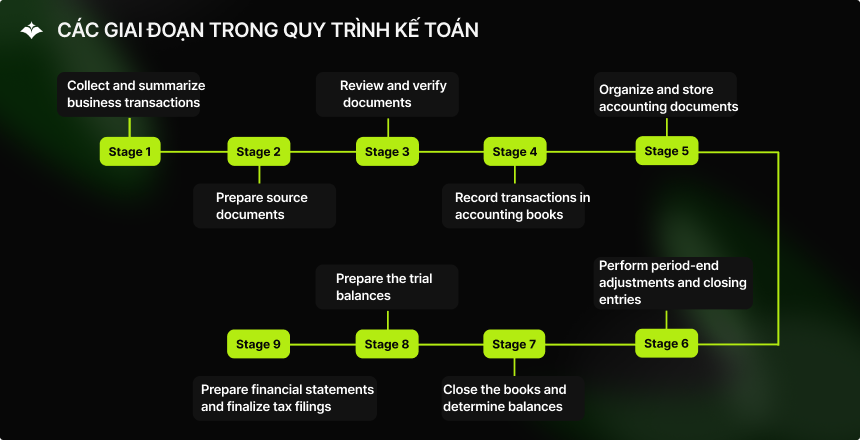
The accounting workflow includes the following steps:
Step 1: Collect economic transactions
Gather all financial transactions across departments such as sales, payments, and cash flows to form the basis for initial documentation.
Step 2: Prepare original accounting documents
Create official documents to record transactions legally and transparently.
Step 3: Verify and process documents
Ensure documents are valid, legal, and accurate before recording.
Step 4: Record accounting entries
Enter data into journals, general ledgers, and sub-ledgers. Accounting software like Genbook helps automate this process, reducing errors and improving data reliability.
Step 5: Organize accounting documents
Classify and store documents systematically for easy retrieval and auditing.
Step 6: Perform period-end adjustments and closing entries
Adjust and summarize data to determine financial performance.
Step 7: Close books and determine balances
Lock records and finalize account balances for reporting.
Step 8: Prepare trial balance
Check the accuracy and balance of accounts before financial reporting.
Step 9: Prepare financial statements and finalize tax reports
Compile key reports, including:
- Balance Sheet
- Income Statement
- Cash Flow Statement
- Notes to Financial Statements
Also complete tax finalization (corporate and personal income tax) and submit on time to avoid penalties.
“A standardized accounting process not only ensures compliance — it builds a reliable data foundation for all business decisions.”
V. Key Competencies of Modern Corporate Accountants
In today’s dynamic and digital-driven business environment, accountants need more than technical expertise. They require a diverse skill set to adapt, analyze, and guide businesses through financial complexities.
Key skills include:
- Analytical and strategic thinking: Turning financial data into actionable insights
- Attention to detail: Ensuring high accuracy to avoid costly errors
- Communication skills: Translating financial data into understandable insights for stakeholders
- Technology proficiency: Using accounting software, ERP systems, and data tools effectively
- Ethics and integrity: Maintaining transparency and preventing financial misconduct
- Time management and adaptability: Handling deadlines and responding to regulatory and economic changes

VI. Q&A on Corporate Accounting
6.1 What accounting methods are used?
Businesses use a combination of methods rather than a fixed approach to accurately reflect financial activities.
6.2 What are the objects of accounting?
According to the Accounting Law 2025, these include:
- Assets
- Liabilities and equity
- Revenue and expenses
- Taxes and obligations to the state
- Business results and profit distribution
- Other related receivables and payables
6.3 What should you study to become a corporate accountant?
Beyond accounting, knowledge in finance, taxation, law, and business management is essential. Common majors include Accounting, Finance, and Business Administration.
6.4 What are the career prospects?
Accounting is a stable and in-demand field, with an estimated annual growth rate of around 10%. Salaries typically range from 8 to 30 million VND per month, depending on experience and role.
VII. Conclusion
Corporate accounting is not just a functional role—it is the backbone of a company’s financial system. Understanding its principles and importance is essential not only for accountants but also for managers and business owners.
VIII. About Genbook
Genbook provides tools that help accounting teams standardize data and ensure financial accuracy in line with accounting standards. Through automation and process optimization, it enhances the reliability of financial reports and supports more effective decision-making.